
WIDIA - Полный каталог инструмента - 2017
для размещения заказа - zakaz@widiahanita.ru
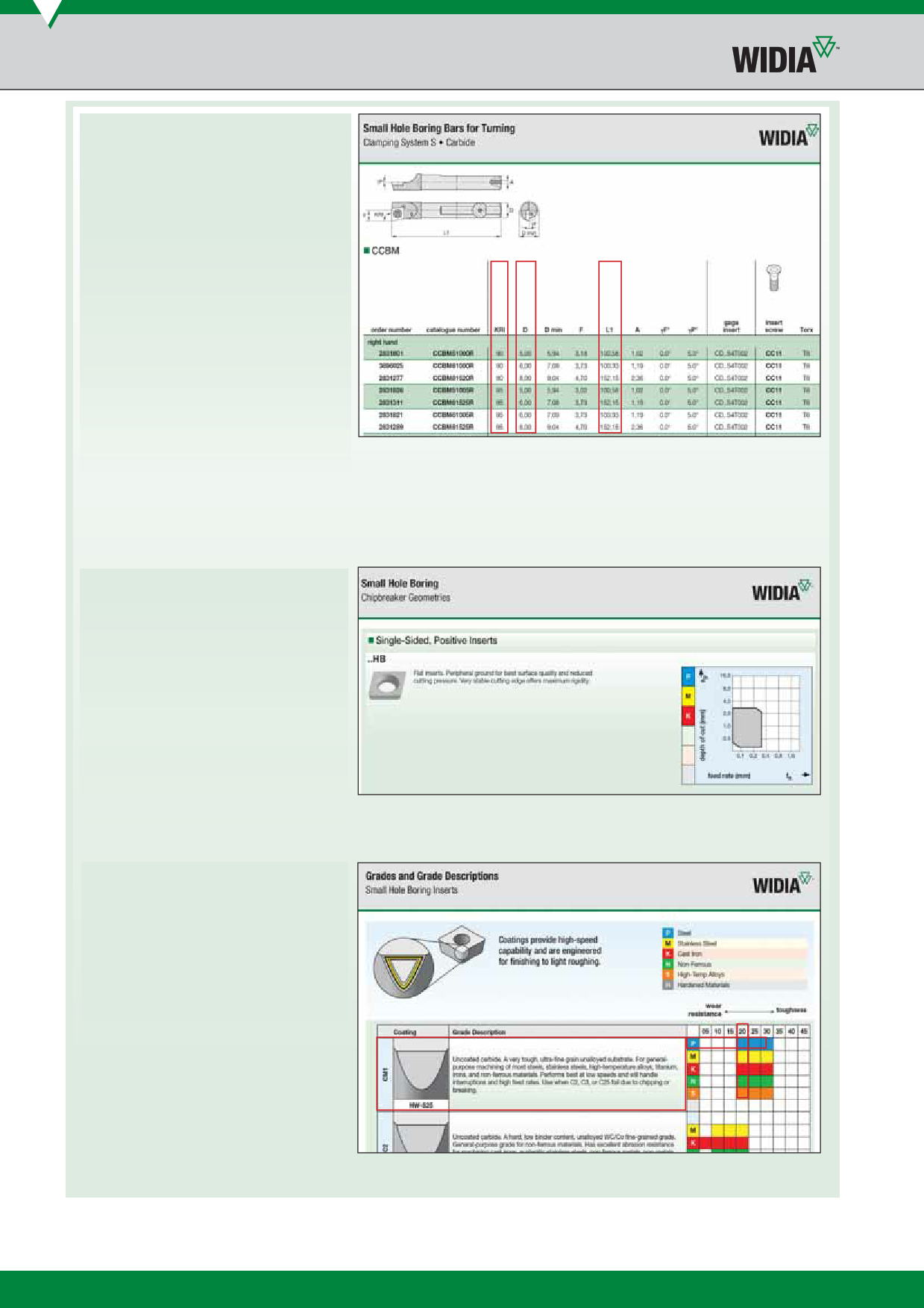
Tool Selection Guide
Choosing the Correct Small Hole Boring Bar
2 Determine boring bar (D).
A Select shank size (D) based on your
machine’s requirements.
B Determine bore depth (how far the
boring bar extends from the holder).
Multiply bar diameter by 4. If bore depth
is less, use a steel bar. If bore depth
exceeds 4:1 ratio, use a carbide bar.
Use L1 or L4 depending on bar selected.
(See recommended maximum overhang
chart on page D86.) For indexable tooling,
go to step 3. For all other
tooling systems, go directly to step 4.
C Determine lead angle (KRA). Zero
degree lead angle is used when maximum
stability is required. Lead angle may vary
based on changing conditions, such as
boring in a blind hole.
CA B
3 Determine which chipbreaker is best
for the material to be machined.
Consult the Small Hole Boring Chipbreaker
Geometry charts on pages D34–D37.
4 Determine which grade is best for the
material to be machined.
Consult the Grades and Grade Descriptions
charts on pages D38–D39.
D6
zakaz@widiahanita.ru
www.widiahanita.ru