
WIDIA - Полный каталог инструмента - 2017
для размещения заказа - zakaz@widiahanita.ru
Hole Finishing
ROTAFLEX™ High-Performance Boring Systems
General Application Hints
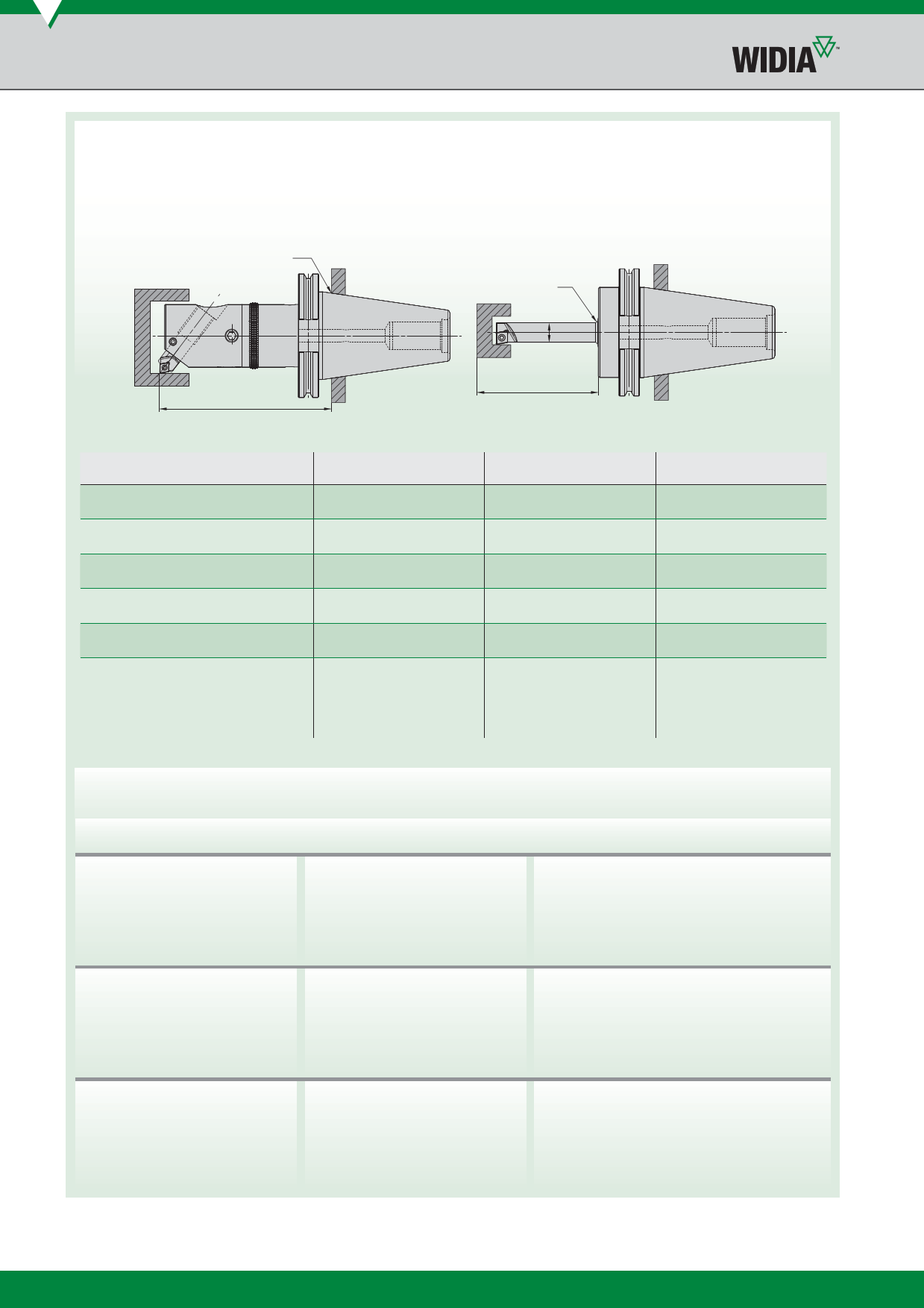
• Identify your critical diameter (D).
• Identify the maximum distance cutting edge (L) to critical diameter.
Here are some examples:
D
D
D
L
Refer to this table for first investigation of application:
Type of Tooling
Twin Cutter Solid Tools
Twin Cutter Bridge Tools
Fine-Boring Heads with Boring Bar (FBHBB)
Fine-Boring Heads (FBH)
Fine-Boring Bridge Tools
Stable
<3,5 x D
<3,5 x D
<3,5 x D
<3,5 x D
<3,5 x D
Function of the tool is
expected without issues
within recommended
cutting data.
L
Unstable
3,5–6,5 x D
3,5–6,5 x D
3,5–5,0 x D
3,5–5,0 x D
3,5–5,0 x D
Tests Necessary
>6,5 x D
>6,5 x D
>5,0 x D
>5,0 x D
>5,0 x D
Application may require
Machining test may
reduced feeds and/or speeds be required to identify
compared to stable conditions. cutting data.
Causes of and remedies for rough and ne boring problems
It is generally assumed that the tools have been properly mounted as per the technical recommendations in this catalogue.
Problem
Cause
Possible Remedy
Vibration tendency
1. Overhang
2. Choice of insert
3. Cutting data
• Adjust L/D ratio
• Select 90° lead angle on rough boring tools
• Select inserts with positive geometry
• Select inserts with smaller corner radius
• Reduce depth of cut
• Increase feed
Slight chatter marks on surface
1. Choice of insert
2. Cutting data
3. Machining environment
• Select 90° lead angle
• Select ground inserts with small edge preparation
• Select inserts with smaller corner radius
• Increase feed
• Increase coolant
Conical bores
1. Choice of insert
2. Cutting data
3. Machining environment
• Select a more wear-resistant insert grade
• Increase cutting speed
• Check whether all screws have been tightened
to recommended torque
W70
zakaz@widiahanita.ru
www.widiahanita.ru