
WIDIA - Полный каталог инструмента - 2017
для размещения заказа - zakaz@widiahanita.ru
Separator™
Technical Recommendations • Separator Cut-Off System
(continued)
Eliminate chatter:
• Minimise tool blade and holder overhang.
• Minimise part overhang.
• Use strongest toolholder system.
• Use a more narrow width of insert.
• Chipbreaker might be too aggressive.
(Call Technical Support.)
• Adjust speed and feed rate up or down.
• Hold workpiece rigidly.
• With a longer part, support with steady rest or live centre.
• Avoid machine dwell.
• Use S2 or X2 to reduce cutting forces.
Reduce cut-off nib on solid bar
or I.D. bur on tubing:
• Check tool height. Insert cutting edge should be on centre to
0,05mm above centreline of workpiece.
• To reduce nib on part, use a high lead angle-type insert. Lead
angle on a cut-off insert reduces the nib, which remains on the
workpiece. CAUTION: the higher the lead, the more tool-side
deflection.
• Use the narrowest possible cut-off insert to minimise the
cut-off bur length.
• Reduce feed rate at the end of a cut.
• On most tubing-type parts, a 4° or 5° lead angle will be
sufficient.
• Add support to a long slender-type part.
• Maintain proper sub-spindle alignment.
• If nib or bur persists, call Technical Support about
reducing hone size.
• Use small- or no-corner radius.
Eliminate built-up edge:
• Select proper grade for insert.
• Increase speed (RPM).
• Increase the feed rate.
• Use ample amounts of well-directed coolant
(see Figure A on page E131).
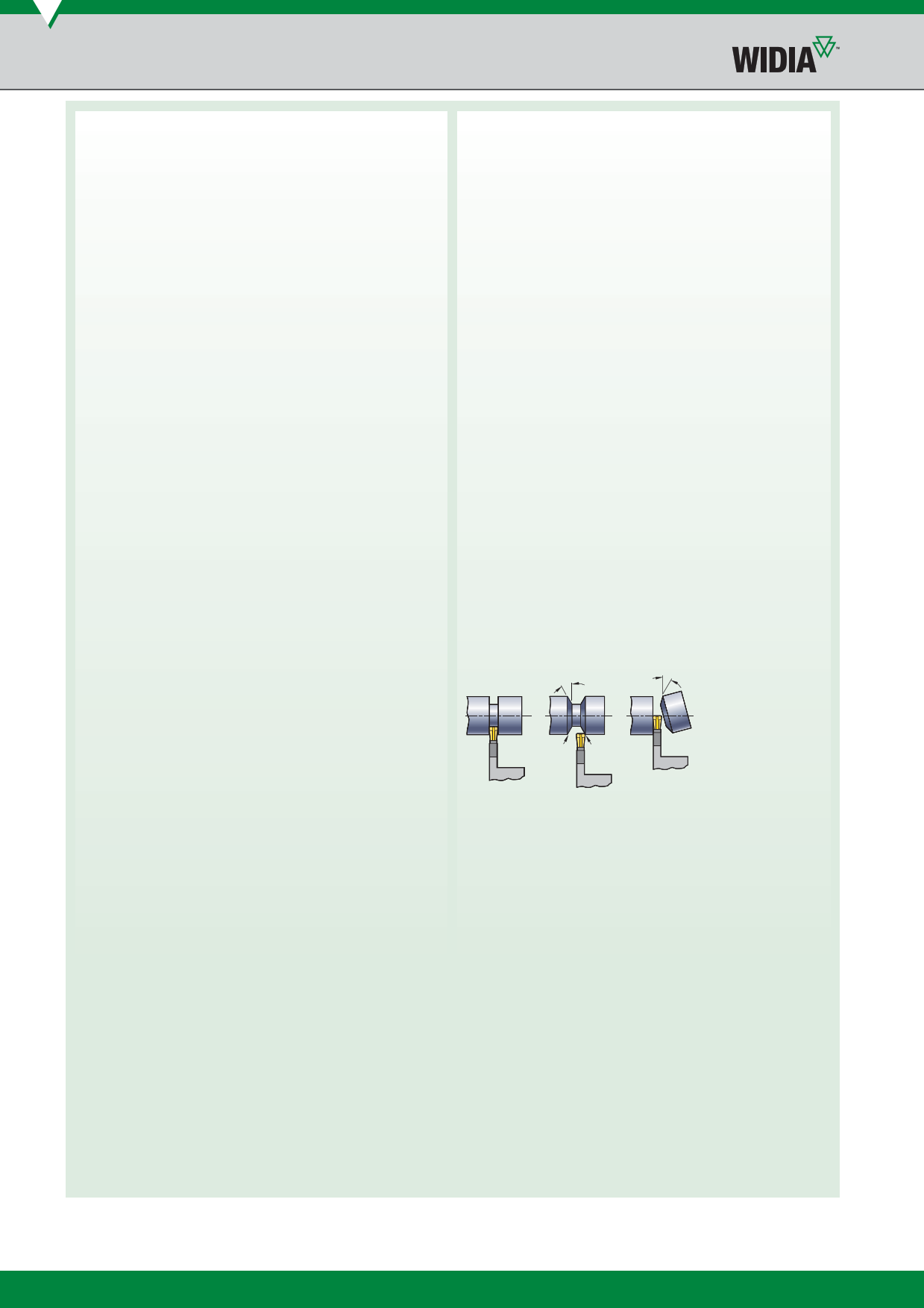
Chamfer and cut-off operations:
• Use Separator S2 or X2.
• Groove or breakdown workpiece surface being machined.
• Machine the chamfer.
• For jobs requiring a chamfer on both ends of the part, begin
by plunging to a depth just beyond the depth of the chamfers.
Then, return to the part O.D. and profile each chamfer
individually. Finish the cut-off after completion of the
second chamfer.
• Cut off the workpiece (see Figure C).
Figure C
E132
zakaz@widiahanita.ru
www.widiahanita.ru